.jpg)
How To Prevent Knee Pain When Running and Avoid Time Off
.webp)
You lace up, step out the door, and halfway through your run, a sharp or nagging pain around the kneecap forces you to slow down or stop, a common test of injury prevention for runners. How to prevent knee pain when running means looking at mechanics, training load, weak hips or quads, tight IT band tissue, and simple fixes like cadence, strengthening, and mobility to stop small aches from turning into patellofemoral pain or chronic overuse injuries. Want to keep running regularly and comfortably without setbacks?
To help you meet those goals, Pliability's mobility app delivers short guided mobility routines, targeted strength work, and easy recovery plans so you can improve alignment, reduce pain risk, and stay active on your schedule.
Summary
- Knee pain is the single largest category of running injuries, accounting for about 42% of all running injuries, and over 60% of runners with knee pain report it was the primary reason they quit, which makes prevention a retention as well as a health priority.
- Most runners will experience knee symptoms at some point, with sources reporting a 70 to 80% lifetime incidence, yet only about 10% of those cases require medical intervention, suggesting that timely, measured responses often prevent escalation.
- False beliefs about running and pain drive two damaging behaviors, avoidance or bravado, and specific diagnoses reflect different roots; for example, patellofemoral pain represents roughly 25% of running injuries and commonly stems from quad and hip imbalances rather than the knee alone.
- Simple movement screens reveal hidden causes, for example, a 10 to 15 centimeter step-down, ankle dorsiflexion tests, and three failed single-leg squats in a row are actionable red flags that should prioritize unilateral hip or ankle work before treating the knee itself.
- Prevention is concrete and measurable: limit weekly mileage increases to about 10%, build baseline strength twice weekly with two sets of 8 to 12 reps and slow 3 to 5 second eccentric descents, and use cadence work around 170 to 180 steps per minute to reduce peak knee loading.
- If conservative measures do not yield consistent improvement within two weeks, or if instability, catching, or progressive swelling appears, seek a physical therapy screening with staged return-to-run goals rather than assuming rest alone will suffice.
Pliability's mobility app addresses this by offering guided mobility, strength, and load-management routines with short daily sessions and straightforward progress tracking to support knee-specific practice and monitoring.
Why Knee Pain Is One of the Top Reasons Runners Quit
.jpg)
Knee pain creeps in quietly, usually as niggle after a long run or a twinge on a downhill, and then it escalates until your training plan collapses. Left unchecked, that slow accumulation turns consistent running into a cycle of two steps forward, one step back, but the truth is, most of this is preventable with predictable, targeted choices.
How Does Knee Pain Usually Sneak Up on Runners?
This pattern appears across road and trail runners: soreness shows up only after you increase volume, add fast reps, or descend repeatedly. The complaint is often local, like pain on the outside of the knee during downhill running, which makes the problem feel personal and baffling.
Those small load spikes, repeated imperfect mechanics, and failing hip or quad control add up over weeks, not seconds, until the knee finally protests.
Who is Most Likely to Get Stuck by This Problem?
Risk clusters by training behavior and anatomy, not luck. According to PTSMC reports on knee pain in runners, approximately 70% of runners experience knee pain at some point in their running careers, suggesting these complaints are the rule rather than the exception and affect both weekend warriors and marathoners alike.
On top of that, a 2025 Runner’s World report on runner’s knee prevalence notes that the condition can affect up to 30% of female runners and 25% of male runners, underscoring how sex, alignment, and training choices influence injury risk.
Why Does a Small Ache Derail an Entire Training Block?
It is exhausting when a single flare forces you off target for weeks. The familiar move is to ice, stretch, and push through, which feels practical until it does not. Pushing through hides the underlying load mismatch and chronic muscle imbalances, so you trade a short-term session for long-term inconsistency.
The Psychology of Injury
The emotional toll matters: motivation dips, planned races get postponed, and healthy habit becomes a source of stress. That frustration is precisely why prevention matters as much as treatment. Most runners handle early soreness with self-care and willpower. That works for isolated, one-off pains, but as volume and intensity climb, those tactics fail because they treat symptoms, not the cause.
Proactive Load Management
Platforms like Pliability provide a different route; they combine objective load tracking, targeted mobility and strength cues, and simple screening protocols so runners identify load spikes and movement faults before symptoms force a rest, preserving weeks of training rather than reacting after the fact.
What Prevents Knee Pain Without Pausing Life?
Treat prevention like maintenance, not punishment. Control weekly load with small, planned increases, prioritize two targeted strength sessions per week focused on single-leg stability and eccentric quadriceps work, and practice downhill technique and cadence adjustments to reduce joint stress.
Think of your knee like the hinge on a frequently used door; a little lubrication and a tightened screw every few weeks prevent a full breakdown. Mobility and soft-tissue work help, but they supplement, they do not replace, consistent strength and sensible progression.
Defining Your Performance Profile
I still need your brand positioning to make this section sing for your audience. Please paste the client’s messaging or tell me which profile to use:
- Sports physical therapy clinic
- Performance-focused coach/app
- Preventive knee-support product brand
- Orthopedic/telehealth practice
The Common Myths About Running and Knee Pain
Running itself is not the villain; incorrect beliefs about pain are. When runners treat knee discomfort as either inevitable damage or a sign they must push harder, they pick the wrong responses and let small, fixable problems become persistent ones. Clear distinctions between hurt and harm, and practical early actions, are what prevent short-term aches from becoming season-ending setbacks.
Why Do These Myths Stick, and Who Benefits From Them?
The familiar story is simple and comforting: if running is bad, stop running; if pain means you are getting stronger, grind through it. That simplicity spreads because it reduces uncertainty and hands control back to the runner, even though it is misleading.
The Recreational Blind Spot
This pattern appears across beginner and recreational runners, who often blame knee pain solely on running and therefore skip the obvious checks of form, footwear, and strength, thereby overlooking correctable causes and addressing them only indirectly. Emotionally, that leaves people resentful and stuck, wanting to keep the habit but afraid of making the wrong choice.
How Do False Beliefs Make You Miss Early Warning Signs?
When pain is framed as either catastrophic or character-building, the only two obvious actions are avoidance or bravado. Both are poor. Avoidance turns you sedentary and weakens the muscles that protect the knee.
The Trap of Normalizing Pain
Bravado, which looks like forcing through runs or masking pain with pills, lets microdamage accumulate. The result is a predictable failure mode: moments of localized soreness are normalized, training spikes persist, and the first truly limiting flare-up occurs after a minor change in load.
A useful rule of thumb is to log location, intensity, and whether pain changes with movement; a two-point sustained rise on a 0 to 10 scale, or pain that limits your stride for more than 24 hours, means you should alter your load, not toughen up.
What People Reach for When They Want a Quick Fix, and Why Those Fixes Fail
Runners default to three familiar moves: buy stiffer shoes, rest until it feels better, or stretch and foam-roll more. Each has a role, but none is a systematic solution. Shoes can change mechanics but cannot replace missing hip strength; rest can calm symptoms while letting weakness persist; more stretching treats tightness without correcting control deficits.
That mismatch explains why minor relief is followed by relapse. Think of the knee like a poorly tuned bicycle wheel: swapping the tire might help one ride, but unless you true the rim and tighten the spokes, wobble returns.
When the Status Quo Breaks, What Do Runners Need?
Most runners manage knee problems with reactive choices because those options are familiar and require no new routines, which makes sense in a busy life. As training complexity increases, that reactive habit fragments recovery and training quality, creating wasted weeks and inconsistent progress.
The Road to Resilience
Solutions like Pliability provide structured mobility and strength progressions, targeted load-management protocols, and tracking so runners follow a predictable path back to consistent training rather than bouncing between rest and relapse. Teams and athletes using structured programs find that they reduce flare-ups while keeping sessions productive.
What Practical Shifts Stop Myths From Doing Harm?
- Start with observable rules, not beliefs.
- Track pain with a simple daily log, prioritize single-leg strength and hip abductor work, and insert controlled eccentric loading for the quads twice weekly.
- If soreness increases after a run and does not improve within 48 hours, reduce volume or intensity rather than repeating the same session.
- Replace open-ended remedies with measurable practices: two sets of single-leg squats to eight controlled reps, three times weekly of a hip hinge variation, and a progressive plan of running loads that raise weekly volume by no more than 10%.
These actions change tissue capacity, movement quality, and confidence more reliably than vague advice to “toughen up.”
Putting the data in context helps reframe fear and urgency. A January 2025 NYRR article examining whether running is bad for your knees notes that around 80% of runners experience knee pain at some point, which helps explain why knee-related myths spread so easily within running communities. The same source reports that only 10% of knee injuries in runners are serious enough to require medical intervention, a reminder that most problems are manageable with the right approach.
Related Reading
- Injury Prevention Strategies
- What is Injury Prevention
- Cold Therapy for Athletes
- Can Tennis Elbow Cause Shoulder Pain
- Basketball Injury Prevention
- How to Prevent Pickleball Injuries
- How To Stop Wrist Pain From Lifting Weights
- Most Common Tennis Injuries
- How Can You Prevent Injury While Cycling
- Injury Prevention for Athletes
What Actually Causes Knee Pain When Running?
Knee pain usually signals a mechanical imbalance or a load problem somewhere else in your chain, not a failing knee joint. Look at poor mobility, asymmetric strength, underactive hips and glutes, training spikes, worn or inappropriate shoes, and faulty running form as the true drivers; fix those, and the knee often quiets down.
What Movement Tests Reveal the Real Weak Links?
After working with runners across a season, the most reliable screens were simple, repeatable checks that expose the cause rather than the symptom. Watch a slow single-leg squat and a timed single-leg balance, and you will see whether the hip abductors and external rotators fire when they should.
Measure ankle dorsiflexion with a knee-to-wall test, and note hip internal rotation compared side to side. These tests reveal the failure modes that cause the knee to absorb excessive forces, because limited ankle motion or a collapsing hip during stance multiply knee loading with every step.
How Do Weak Hips and Glutes Change Knee Mechanics?
Weak hip abductors and gluteal muscles allow the thigh to fall inward, increasing lateral pull on the kneecap and joint shear. “Many runners have strong quadriceps, but weak hip abductors and hamstrings,” explains Dr. Schaner, and that imbalance shifts the burden onto the patellofemoral joint. In plain terms, the knee becomes the emergency backup generator, taking load it was never designed to handle.
How Does Training Load Itself Betray You?
“We often see knee pain if runners increase their volume of training too quickly,” Dr. Schaner says, and that observation is a clinical pattern, not a platitude. When a weekly session or long run jumps without staged adaptation, the tendon and cartilage tolerate repeated microstress until pain flags the mismatch.
A steady, measurable progression in volume and intensity is not optional; it is the mechanical insurance policy that prevents overload.
Which Knee Diagnoses Should You Expect to Encounter?
Clinical summaries show the same trio keeps appearing, so treat the diagnostic labels as signposts for where to look.
Clinical Diagnosis vs. Root Cause
According to Quality in Sport on running-related knee injuries, the most common conditions are:
- Patellofemoral Pain Syndrome (PFPS)
- Iliotibial Band Syndrome (ITBS)
- Patellar Tendinopathy (PT)
These highlight key areas for prevention and targeted care.
Mechanics Over Structural Failure
These conditions point toward movement and load problems rather than sudden structural collapse. If you see PFPS, look at hip control and quad symmetry. If you see ITBS, look at lateral hip strength and repeated friction from an altered gait.
How Often is the Knee the Primary Problem Versus the Messenger?
Data from recent reports underline the dominance of knee complaints in running, making their correct interpretation urgent.
The Smoke Alarm Principle
According to PTSMC, knee pain accounts for approximately 42% of all running injuries, underscoring the need for clinicians and coaches to treat it as a common signal rather than an isolated event and to investigate upstream causes. Think of the knee as a smoke alarm, not the house fire; you silence the alarm, but if you do not find the fire, it comes back.
What Role Does Footwear and Surface Adaptation Play That Most People Miss?
Shoes are a tool with limits. Age, stack height, and stability affect how forces are transmitted up the leg, and abrupt swaps or worn cushioning alter stride mechanics. Similarly, switching surfaces gives muscles different moment arms and timing, which “may just need more time to adapt to the change,” says Dr. Schaner.
The failure mode is predictable: when adaptation time is short, neuromuscular control lags, and the knee picks up the slack.
When Should You Accept Conservative Care and When to Escalate?
Most running knee problems respond to targeted, non-surgical approaches that correct movement and loading, which means early appraisal and guided rehab buys time and keeps training salvageable.
If pain becomes sharp, causes instability, produces catching, or prevents daily activities like stair climbing, then escalate to diagnostic imaging and specialist review, because those signs suggest structural damage rather than an overuse pattern.
Why Single-Leg Work and Progressive Loading Fix More Than Icing and Stretching
Targeted motor-control drills followed by progressive, specific strength work, retrain timing and load sharing. Start with low-load, high-quality single-leg control for 4 to 8 weeks, then layer resisted hip abduction, eccentric quadriceps deceleration, and slow, loaded step-downs. That sequence resets movement patterns so the knee stops being asked to lead.
As Dr. Schaner notes about overuse states, addressing the muscles and tendons that surround the joint solves the problem in the long run.
The Trap of Tactical Fixes
Most people treat knee pain with familiar quick fixes, and that makes sense because they are immediate and require no change. The familiar approach is icing, adding a sleeve, and hoping it settles so training resumes. That tactic works short-term, but as sessions accumulate and intensity rises, small compensations compound into:
- Chronic restriction
- Lost weeks of training
- Repeated flares
Solutions like Pliability offer a different path; they combine objective load monitoring, quick movement screens, and targeted cues so runners identify mechanical faults and cadence or surface adaptation needs before a niggle becomes a forced break.
Practical Diagnostic Checklist You Can Use Right Away
- Video a runner from behind at slow speed for 30 seconds, then watch for hip drop, knee valgus, and trunk lean.
- Time a single-leg balance to 30 seconds; anything less than clean control signals a priority for hip motor work.
- Use a knee-to-wall ankle dorsiflexion test to check if ankle stiffness may be driving knee compensation.
Each item isolates a constraint, so your corrective work targets the true failure mode instead of just numbing the symptom.
The Human Side Matters as Much as the Technical Side
It is exhausting when a runner, often under 30, feels fragile despite months of self-care and physiotherapy, wanting answers and quick fixes. After working with athletes who felt that way for a season, the consistent emotional pattern was relief when the diagnosis shifted from “broken knee” to “repairable imbalance,” because that gives agency.
A clear, staged plan restores confidence:
- Assessment
- Low-load motor work for 4 weeks
- Progressive strength for another 6 to 8 weeks
- Then measured return to targeted running, with objective load checks throughout
That simple diagnostic shift changes how you respond to pain and sets up what you need to do next, which is not what most runners expect. But the real reason this keeps happening goes deeper than most people realize.
Related Reading
- Do Muscle Tears Heal On Their Own
- Forearm Strain
- How Can Strengthening Muscles Prevent Injury
- Quad Strain Recovery Time
- Urgent Care For Pulled Muscle
- How To Heal A Calf Strain Quickly
- How To Prevent Hamstring Injuries
- How Long Does a Sprained Knee Take to Heal
- How Does Stretching Prevent Injury
- How Long Should Swelling Last After an Injury
- How To Strengthen Shins For Running
- Athletic Injury Recovery
How to Prevent Knee Pain When Running With Smarter Training and Movement
Prevention rests on three actions you can control:
- Manage load smartly
- Increase the knee’s support through targeted strength and mobility
- Remove hidden stresses like poor sleep, dehydration, or sloppy technique
Do those three consistently, and you turn knee pain from an unpredictable threat into a predictable training variable you can change. According to Hinge Health’s guide on preventing knee pain in runners, approximately 70% of runners experience knee pain at some point in their running careers, making prevention a matter of practical planning rather than choice.
Stay Hydrated & Lubricate Joints
What should you actually do before a run?
- Drink to keep urine pale gold, not dark. Two practical rules work:
- Top up fluids about two hours before hard sessions
- Sip small amounts during runs longer than 45 minutes to avoid a 1.5% fluid loss that changes focus and movement.
- Add a small electrolyte drink when sweat is heavy, and use that as a gateway to better joint lubrication and steadier cadence on longer efforts. If you notice morning stiffness that lifts after a short warm-up walk, that is your cue to prioritize that pre-run sip and a 5 to 10-minute loosener before hitting pace.
Prevent Injury with Pre & Post Run Stretching
Which stretches should you do, and when? Treat the warmup like a technical rehearsal, not a flexibility class. Before runs, use dynamic movements that load the pattern you run with, for example, 6 to 8 leg swings each side, 10 walking lunges with rotation, and 20 meters of A-skips to prime hip extension and cadence.
Targeted Post-Run Restoration
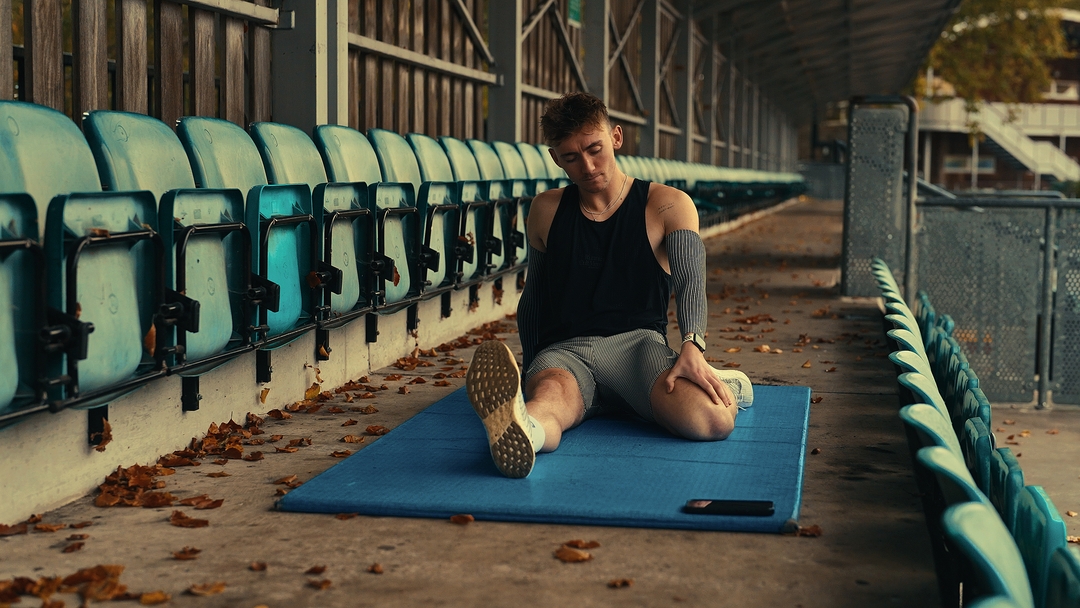
After the run, hold static stretches for 30 to 45 seconds, focusing on the quads, IT bands, calves, and glutes, only after a brief cool-down walk to warm the tissues. If tightness is localized to one side, add an extra minute of targeted release and follow with a light activation set so the weak side does not get left behind.
Strength Training and Knee Joint Support
The knee fails when the surrounding muscles cannot absorb or redirect load.
- Build a minimum baseline twice weekly, not as an optional add-on.
- Start with two sets of 8 to 12 controlled reps of loaded split squats, Romanian deadlifts, and glute bridges, then progress to single-leg variants once pain is under control.
- For tissue tolerance, include slow eccentric work for the quads, such as controlled 3- to 5-second descents on a step-down.
These slow eccentrics alter how the patellar tendon and quadriceps respond to repeated loading, directly addressing the tracking and overload issues that cause front-of-knee soreness.
Strengthen Your Leg Muscles and Core
Pattern recognition shows unilateral weakness wrecks tracking long before a flare-up appears.
Add single-leg balance progressions, farmers carries, and 30 to 60 second planks into two short sessions each week. Use objective checks to guide progression. For example, when a single-leg squat reaches 10 degrees less valgus and feels controlled, you raise the load.
Short, heavy carries and tempo single-leg work transfer immediately to a better running posture and less knee torque.
Use Cold Therapy on Sore Knees
If you have an acute flare after a session, cold reduces pain and neural drive for several hours. Sit in cold water for 5 to 10 minutes, or apply a 15 to 20-minute ice pack to the front of the knee twice daily, especially in the first 48 hours after a hard stimulus.
Avoid chronic overuse of ice right after strength work if your goal is adaptation, because repeated cold exposure can blunt strength gains; use it strategically to buy recovery time when you need to reduce pain and stick to your training plan.
Pace Yourself
Raise the weekly load only when the capacity is visibly improving. Instead of a blind percentage jump, use two signals to increase distance or intensity, both present for two consecutive weeks: improved single-leg control and pain-free post-run checks at 24 hours.
When either signal fails, cut volume or intensity and rebuild with shorter intervals or run-walk progressions to allow tissue to adapt without relapse.
Improve Your Running Technique
The critical change you can practice is cadence. Running with a cadence of 170-180 steps per minute can reduce knee impact, so use a metronome or phone app to increase your cadence by 3 to 5 percent, maintaining that for 5 to 10 minute blocks before checking how your knees feel.
Visualizing Impact Mechanics
Practice landing softly, keeping hips stacked and knees just slightly bent at contact. Video a few strides at an easy pace every two weeks and compare; the smallest change, like eliminating an overstride or reducing forward trunk lean, often drops peak knee loading more than an extra set of squats.
Maintain a Healthy Body Weight
If you carry extra mass, reduce knee load through a combined approach, not dieting alone. Small, sustainable reductions achieved with better sleep, a protein-forward breakfast, and consistent activity reduce repetitive joint stress while preserving muscle. Focus on preserving or increasing lean mass while trimming fat so your knee support improves as mass decreases.
Incorporate Flexibility Training
If ankle dorsiflexion limits your knee bend, treat it first. Use two daily mobility micro-sessions, each 4 to 6 minutes, including ankle rocker drills, hip internal rotation with bands, and prone quad releases.
Track improvement with a simple lunge test; when dorsiflexion increases by a measurable amount, the stride becomes more forgiving, and the knee stops compensating for lost mobility elsewhere.
Choose the Right Running Shoe
The right shoe is a tool that complements your mechanics. Get a short gait assessment on a treadmill, note where your foot lands relative to your center of mass, and choose a shoe that encourages neutral alignment rather than extreme correction.
Replace shoes when midsole compression and ride feel change, or when a gentle run feels harsher than before; don’t wait for visible sole wear to decide.
Get Plenty of Rest
Specific sleep habits change recovery. Aim for consistent sleep windows and prioritize temperature control, minimal blue light in the hour before bed, and a 20 to 30 minute wind-down to lower overnight inflammation markers. When sleep is poor two nights before a hard workout, downgrade the session; that small decision reduces the risk of an injury-producing spike.
Don’t Ignore Knee Pain
Persistent pain is a signal, not a badge of toughness. Log location, load, and pattern for 48 to 72 hours; if pain intensifies with the same stimulus or limits stride length, reduce or change the activity. Red flags that require urgent evaluation include new instability, locking events, or progressive swelling after activity.
Can I Treat Knee Pain at Home?
If symptoms are mild, follow a graded home plan: short-term protection and early isometric loading to calm pain, then progressive tolerance. For example, start with quad sets and straight-leg raises, three times daily, then move to loaded closed-chain movements like two-legged squats and controlled step-ups as pain allows.
Use the PEACE and LOVE mindset for staging recovery: protect briefly, then gradually restore load and aerobic vascularization.
Breaking the Cycle of Passive Recovery
Most teams handle rehabilitation the same way because it is familiar: rest, random stretches, and a hope that time fixes everything. That approach works briefly for minor soreness, but when you add training complexity, those habits allow weakness and poor movement to return, creating recurring flare-ups.
Systemizing Athletic Longevity
Solutions like Pliability change that path by centralizing mobility and strength progressions, tracking movement scores, and giving run-specific load-management templates that keep training productive while lowering relapse risk.
Teams find that structured programs like this replace guesswork with predictable progress, keeping runners on schedule without sacrificing long-term resilience for short-term comfort.
What To Do If Knee Pain Doesn’t Improve
If you see no consistent improvement after two weeks of conservative home care, or if function worsens, book a physical therapy screening. Ask the clinician for a prioritized plan with measurable goals, such as restoring single-leg squat symmetry or returning to pain-free 10-minute jogs, and insist on a staged return-to-run protocol rather than a simple clearance.
Imaging is useful when mechanical screens show instability, catching, or loss of range, but most cases respond to targeted rehab when it is applied early and measured.
Bridging the Gap to Performance
It’s frustrating to train around pain and still feel stuck, but there is a predictable path forward if you track load, strengthen the weak links, and use targeted tools to speed recovery. That simple change buys clarity, but the deeper mobility issues behind the pain are what most runners still miss.
Related Reading
- How To Prevent Stress Fractures From Running
- How To Fix Lower Back Pain From Running
- Care And Prevention Of Athletic Injuries
- Knee Injury Prevention Exercises
- Compression Therapy For Athletes
- Soccer Injury Prevention Exercises
- Best Foam Roller For Runners
- Ankle Injury Prevention Exercises
Protect Your Knees by Fixing the Mobility Issues Behind the Pain
I tell runners to make mobility a short, daily habit that fits into warm-ups and cool-downs, because small losses of range of motion compound until they force you off your schedule. If you want a simple way to build that routine and keep your knees strong, consider Pliability, which helps you follow targeted daily mobility and recovery work to improve stride efficiency and reduce joint stress.
.jpg)